RadSecProxy for Converted Networks
radsecproxy is a generic open source RADIUS proxy that, in addition to the usual RADIUS UDP transport, also supports TLS (RadSec).
The project can be found at https://radsecproxy.github.io/
Helium makes a preconfigured and containerized version of this project available at https://github.com/novalabsxyz/radsec-proxy
Hardware Requirements
RadSecProxy is designed to be lightweight and not require many hardware resources as it scales. Below are suggested hardware specs that will support small (tens of Wi-Fi APs) to medium (up to 1000 APs) deployments.
- Quad-core CPU, e.g. Intel i5 or better
- 2 GB RAM minimum, 4 GB for bigger deployments
- 1.25 GB free disk space
- Docker-supporting OS (Windows, macOS, Linux)
- 1 Gbps Ethernet port
- RadSecProxy typically uses ports 2083 and 443 for RadSec communication.
- Ensure these ports are open and accessible outbound from the proxy.
- If using RADIUS/TLS, also ensure ports 1812 (UDP/TCP) and 1813 (UDP for accounting) are open.
Local Deployment Options
The typical deployment used by converted Helium networks is to deploy an instance of RadSecProxy locally within the deployer-controlled network. This can take two forms depending on how the deployer-controlled network is structured.
Secured Remote Sites - Local
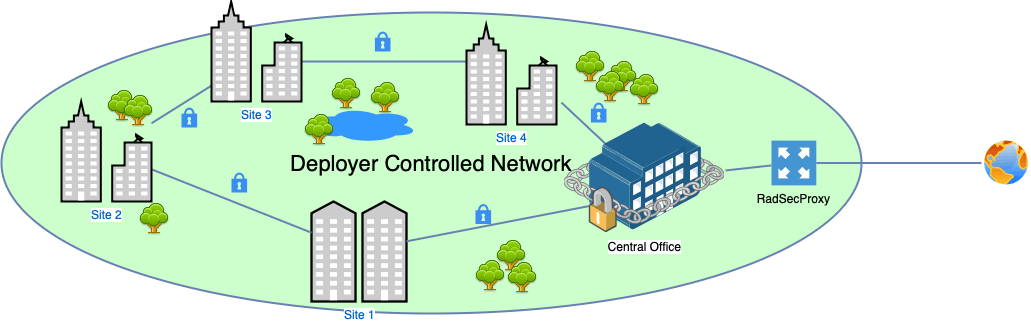
In this deployment model the Deployer has existing secure links between its remote sites and a central office where common infrastructure is housed. In this case, the RADIUS from Wi-Fi APs at the remote sites is secured back to the central office where an instance of RadSecProxy can be deployed. This one instance of RadSecProxy can then be used by all the APs in remote sites 1-4.
Unsecured Remote Sites - Local
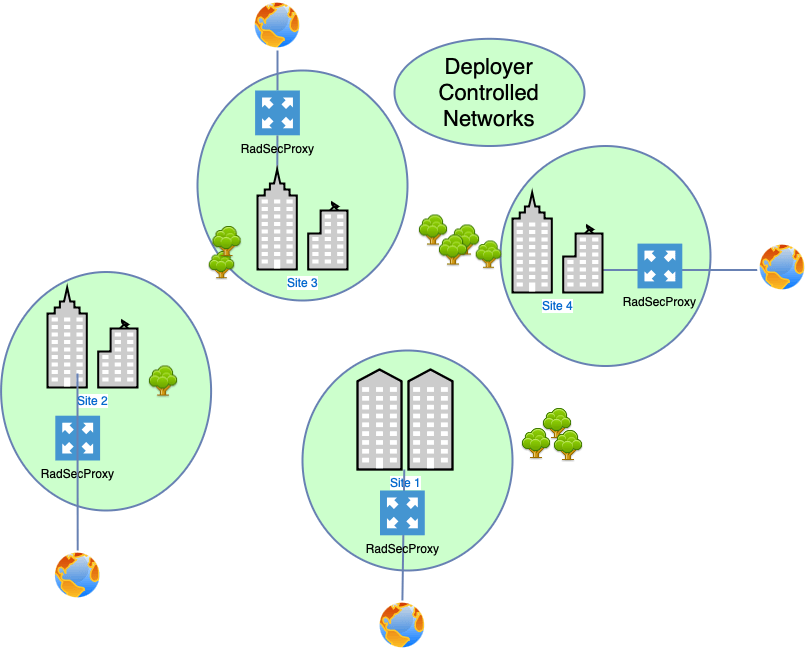
In this deployment model the Deployer has multiple remote sites, each of which is connected directly to the internet with no secure link back to a central office location. In this scenario an instance of RadSecProxy can be deployed locally at each site to securely proxy RADIUS traffic to Helium over the open internet.
Cloud Deployment Options
If the deployer is unable to deploy an instance of RadSecProxy locally using the options above, another option is to purchase access to a cloud instance of RadSecProxy hosted by Helium. In this deployment model each deployer site must be connected via IPsec VPN to the cloud instance to ensure safe transport of unencrypted RADIUS to the proxy.
Secured Remote Sites - VPN
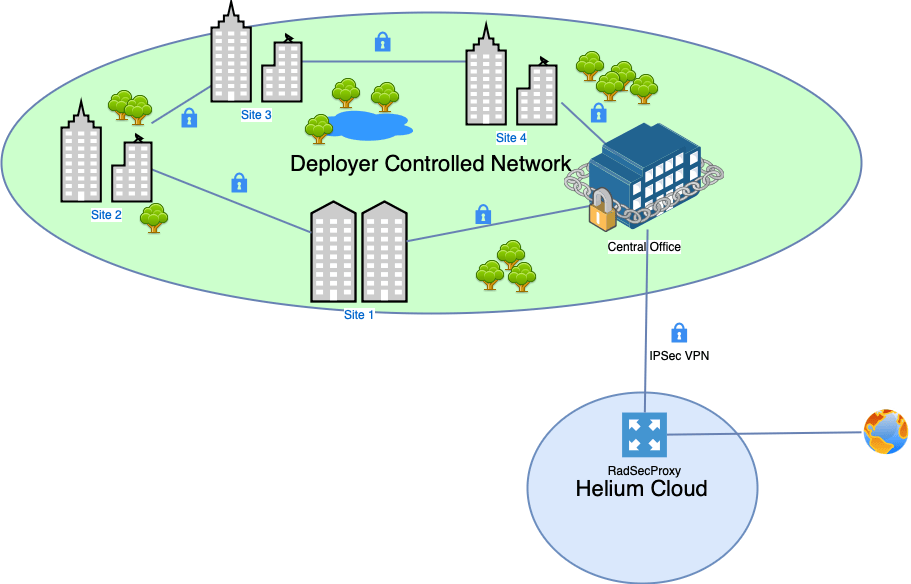
In this deployment model the Deployer has existing secure links between its remote sites and a central office where common infrastructure is housed. However, the deployer is unable to deploy a local instance of RadSecProxy. Instead the Deployer can purchase access to a cloud-hosted instance of RadSecProxy managed by Helium. The Deployer then establishes an IPsec-based VPN link to the cloud RadSecProxy.
Unsecured Remote Sites - VPN
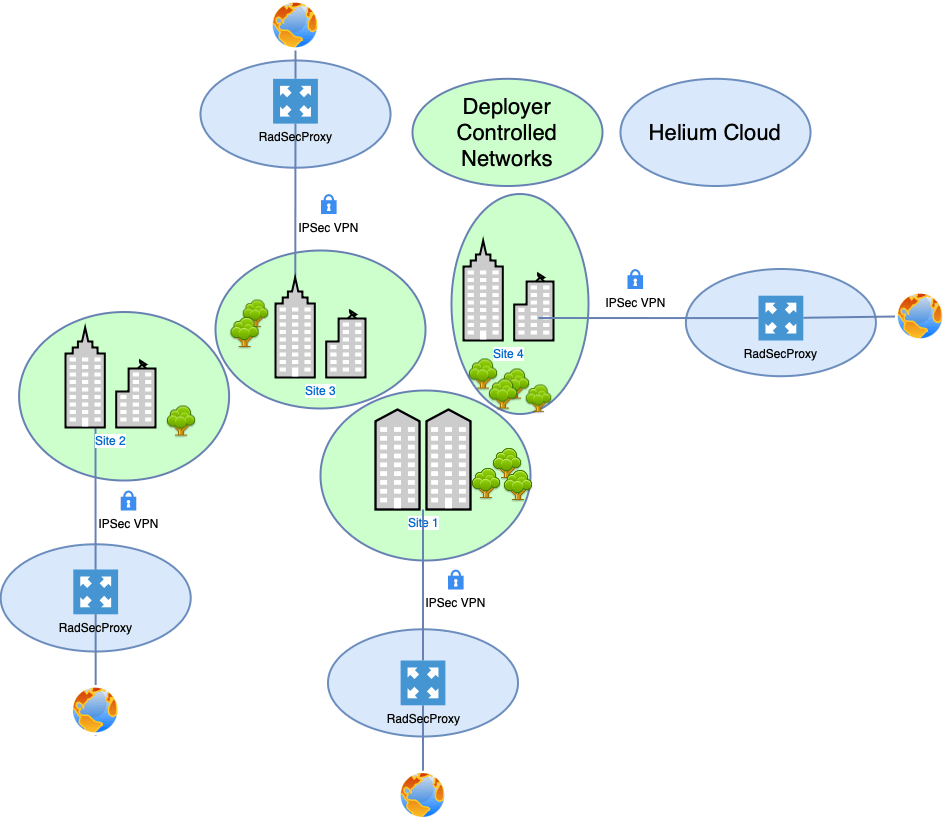
In this deployment model the Deployer has multiple remote sites, each of which is connected directly to the internet with no secure link back to a central office location. In this scenario the deployer can purchase access to a cloud-hosted instance of RadSecProxy managed by Helium. Each site is then connected to the cloud instance using an IPsec VPN to secure the link.